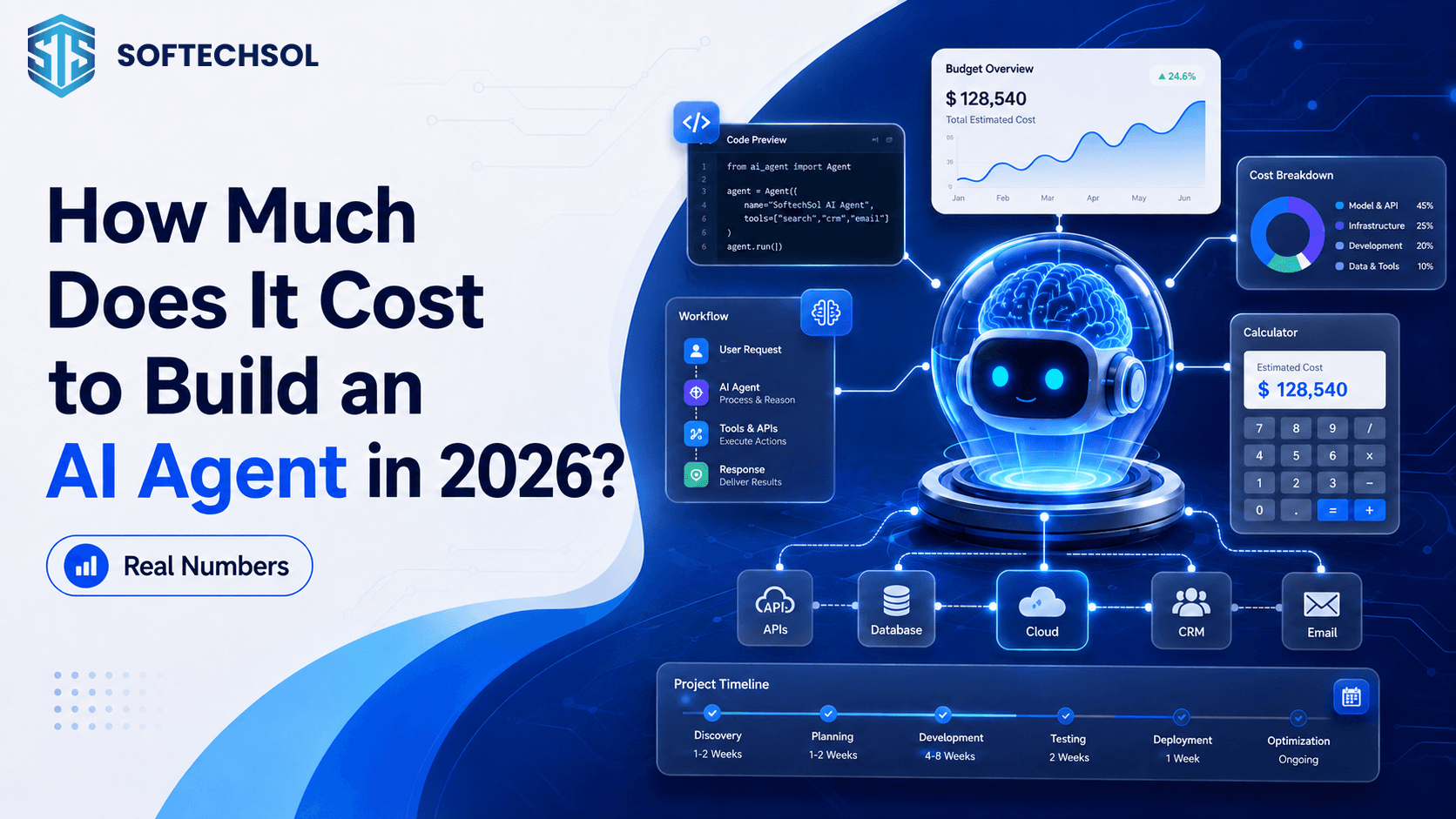
How Much Does It Cost to Build an AI Agent in 2026? (Real Numbers)
Building an AI agent in 2026 costs anywhere from $1,000 to $150,000+, depending on complexity, integrations, and who builds it. A simple task-specific agent can be delivered for $1,000 to $5,000, while enterprise-grade multi-agent systems run well into six figures.
If you've researched AI agent development cost before, you've probably noticed a frustrating pattern: every guide says "it depends" and then quotes ranges so wide they're useless. This guide is different. We recently built a complete end-to-end AI sales outreach agent for a client, and in this article, we'll show you exactly what it did, what it cost, and how long it took. No guesswork, just real numbers from a real project.
What Is an AI Agent? (A 30-Second Refresher)
An AI agent is software that doesn't just answer questions; it takes action. Unlike a basic chatbot that follows scripted replies, an AI agent can read information, make decisions, use tools (like your email, calendar, or CRM), and complete multi-step tasks on its own. Think of it as a digital employee: you define the goal, and it figures out the steps.
AI Agent Development Cost in 2026: The Quick Breakdown
Here's what building an AI agent actually costs in 2026, based on current market data and our own project experience:
Agent Type | What It Can Do | Cost Range | Timeline |
|---|---|---|---|
Simple Agent | Single task, 1–3 integrations (e.g., auto-reply bot, FAQ agent) | $1,000 – $10,000 | 1–3 weeks |
Mid-Level Agent | Multi-step workflows, 4–8 integrations, decision-making (e.g., sales outreach automation) | $10,000 – $50,000 | 4–10 weeks |
Complex/Enterprise Agent | Multi-agent systems, compliance, custom infrastructure | $50,000 – $150,000+ | 3–6+ months |
Why do these ranges vary so much? Because most published estimates come from large agencies in the US and Western Europe. Industry guides place entry-level agents at $20K to $30K, mid-tier at $30K to $60K, and complex builds at $60K to $100K+, while some agencies report multi-step autonomous agents that handle real business workflows costing $50,000 to $150,000.
But here's what those guides don't tell you: the same functionality can cost a fraction of that depending on your development partner's location and approach. We'll prove it with a real project below.
Real Example: What We Built at Softechsol (and What It Cost)
Instead of quoting theoretical numbers, let us show you a real AI agent. We recently delivered for a client an end-to-end AI-based sales outreach automation system that handles everything from lead capture to meeting booking, without human intervention.
What the AI Agent Does
The system automates the client's entire sales outreach pipeline:
Lead capture: The moment a new lead arrives from Apollo, a webhook pushes it directly into the system.
Duplicate check: The agent verifies against the CRM whether the lead already exists.
Personalized cold emails: The AI writes a unique outreach email for every single lead based on their name, company, and job title. No two emails are the same.
Auto-send and status tracking: Emails go out automatically, and each lead's status updates in real time.
Proposal generation: When a lead requests a proposal, the AI generates a professionally styled document, converts it to PDF, and emails it directly to the prospect.
Reply handling: The agent reads incoming replies and classifies them: is this a general question, or is the prospect confirming a meeting time?
Meeting auto-booking: If a prospect says something like "this Friday works", the AI calculates the actual date, books the meeting on Google Calendar, adds the prospect as a guest, and sends a confirmation email all on its own.
The Tech Stack
We built the entire system on n8n (workflow orchestration), powered by the Groq API running Llama-4-Scout as the agent's brain, with Apollo, Gmail, Google Sheets, Google Drive, and Google Calendar as integrations. n8n handles the plumbing, moving data and managing triggers, but every task that requires thinking or writing is handled entirely by the AI.
The Hardest Parts (Where the Real Cost Lives)
The expensive part of AI agent development isn't connecting APIs; it's making the agent reliable. Our toughest challenges were:
Synchronizing three separate triggers (webhook, sheet updates, and incoming emails) in one workflow without conflicts
Prompt engineering the AI to always produce clean, professional output: no filler lines, no broken formats
Parsing natural language dates ("this Friday works") into actual calendar bookings
Classifying replies accurately, because the next automated step depended entirely on that decision
Total cost | $1,200 |
|---|---|
Delivery time | 17 days |
Integrations | 6 (Apollo, Gmail, Sheets, Drive, Calendar, Groq) |
Human work replaced | Lead research, email writing, proposal creation, reply handling, meeting scheduling |
Compare that with the $20,000 to $60,000 that most agencies quote for a mid-level agent with similar functionality. The difference isn't quality; it's smart architecture choices (using n8n instead of custom code and cost-efficient LLM APIs instead of premium models) and development location.
What Factors Affect the Cost to Build an AI Agent?
If two companies quote you $5,000 and $80,000 for the "same" AI agent, neither is necessarily lying. These five factors explain the gap:
1. Complexity and Scope
A single-task agent (auto-replying to emails) is a weekend project. An agent that captures leads, writes personalized emails, generates proposals, and books meetings like the one above requires multi-trigger orchestration and careful decision logic. Every additional "thinking step" adds development and testing time.
2. Number of Integrations
Each system your agent connects to the CRM, email, calendar, and payment gateway adds development hours. Industry data suggests every integration adds roughly $2,000 to $5,000 at typical agency rates. Our project had six integrations; at standard agency pricing, integrations alone would have exceeded our entire project cost.
3. LLM and API Choices
This is 2026's most underrated cost factor. Premium models like GPT-4o or Claude cost significantly more per token than efficient alternatives. We used Groq's API running Llama-4-Scout fast and reliably and at a fraction of premium model pricing. For most business automation tasks, you don't need the most expensive brain; you need the right one.
4. Developer Location: Pakistan vs UK Rates
Where your development team sits changes everything:
Region | Typical Hourly Rate | Mid-Level Agent Cost |
UK / Western Europe | $60 – $120/hr | $25,000 – $60,000 |
USA | $80 – $150/hr | $30,000 – $80,000 |
Pakistan / South Asia | $15 – $35/hr | $1,500 – $15,000 |
The talent gap has closed dramatically; the same n8n workflows, the same LLM APIs, and the same architecture patterns are used globally. For UK businesses, this is exactly why outsourcing AI agent development to Pakistan has become a serious cost strategy rather than a compromise.
5. Maintenance and Running Costs
The build cost is only chapter one. API usage, hosting, and workflow monitoring typically add 15–25% of the initial build cost annually. A well-architected agent (efficient prompts and lightweight models) keeps these running costs low, something worth asking any vendor before you sign.
Hidden Costs Nobody Tells You About
Most AI agent quotes cover development only. Here's what usually surfaces after the contract is signed:
API and token costs. Your agent's brain runs on LLM API calls, and these bills arrive monthly, forever. Depending on volume, ongoing API usage can run from $100 to several thousand dollars per month. An agent processing 10,000 leads a month costs far more to run than one handling 200. Ask for a usage estimate upfront.
Prompt engineering and refinement. Getting an AI to produce consistent, professional output every single time is harder than it looks. In our sales outreach project, detailed prompt engineering was one of the most time-consuming parts, eliminating filler lines, enforcing formats, and keeping the tone right across thousands of unique emails. Budget for iteration, not just the first version.
Testing edge cases. What happens when a prospect replies "maybe next week sometime"? Or when two triggers fire simultaneously? Reliable agents need extensive edge-case testing, and industry analysts note that teams who underfund testing usually pay for the rework later.
Maintenance and breakage. APIs update, integrations change, and models get deprecated. Annual maintenance typically runs 15–25% of your initial build cost. A $1,200 agent might cost $200–$300 a year to maintain a $60,000 agent, proportionally more.
The cost of building the wrong thing. The most expensive AI agent is the one nobody uses. Vague scope ("automate our sales somehow") leads to bloated builds. A focused scope can cut initial costs by 30–50%; know exactly which task you're automating before you brief a developer.
How to Reduce AI Agent Development Costs
Based on what we've learned building agents in production, here's how to get the most value without cutting corners:
Start with one workflow, not a "do-everything" agent. Trying to automate your entire business in version one inflates costs and delays launch. Our client didn't ask for a general sales AI; they asked for one pipeline: lead in, meeting booked. That focus is why it shipped in 17 days.
Use orchestration platforms instead of custom code. Tools like n8n handle triggers, data movement, and integrations out of the box. Building that plumbing from scratch can add weeks of engineering time for zero extra business value.
Choose cost-efficient LLMs. Premium models are overkill for most business tasks. Efficient models via providers like Groq deliver the reasoning quality most workflows need at a fraction of the token cost, and that saving compounds every month your agent runs.
Reuse your existing tools. Our client's CRM ran on tools they already used daily. No new software licences, no team retraining – the agent worked around their existing stack, not the other way around.
Work with a team that has shipped real agents. An experienced team avoids the expensive trial-and-error phase, the trigger conflicts, the prompt failures, and the date-parsing bugs because they've already solved those problems. If you're exploring agentic automation for your business, our team at Softechsol offers AI agent development services and can scope your first agent with a realistic, transparent quote.
FAQs About AI Agent Development Cost
How much does it cost to build an AI agent in 2026?
Anywhere from $1,000 to $150,000+. Simple single-task agents cost $1,000–$10,000, mid-level multi-integration agents run $10,000–$50,000 at typical agency rates, and enterprise multi-agent systems exceed $50,000. Development location dramatically affects the price. We delivered a six-integration sales automation agent for $1,200.
How long does it take to build an AI agent?
Simple agents take 1 to 3 weeks, mid-level agents 4–10 weeks, and enterprise systems 3 to 6+ months. Our end-to-end sales outreach agent was delivered in 17 days.
What are the ongoing costs after building an AI agent?
Expect monthly LLM API fees (from $100 upward depending on volume), plus annual maintenance of roughly 15 to 25% of your initial build cost for updates, monitoring, and integration fixes.
Is it cheaper to build an AI agent with no-code tools like n8n?
Significantly. Orchestration platforms like n8n eliminate weeks of custom backend work. However, the AI logic – prompt engineering, reply classification, and output reliability – still requires real expertise. The platform is cheap; making the agent dependable is the skilled part.
Should UK businesses outsource AI agent development to Pakistan?
Cost-wise, it's compelling: the same tech stack and architecture at $15–$35/hr versus $60–$120/hr locally. The key is choosing a team with shipped production agents and clear communication. Evaluate portfolios and real project case studies, not just rates.
The Bottom Line
AI agent development cost in 2026 depends far less on the technology and far more on who builds it and how. The tools are n8n, efficient LLM APIs, and ready integrations that are accessible to everyone. What you're really paying for is the expertise to make an agent reliable: handling edge cases, engineering consistent prompts, and architecting workflows that don't break.
If a $1,200 agent can capture leads, write personalized emails, generate proposals, and book meetings autonomously, the question isn't whether you can afford to build an AI agent; it's how much manual work you can afford not to automate.
Ready to scope your first AI agent? Get in touch with Softechsol for a transparent, real-numbers quote.
About the Author: Mr Moeen and Syed Hasan Kamran Bukhari are RPA Developers at Softechsol, where they design and build production AI agents and workflow automation systems for international clients. His recent work includes end-to-end sales outreach automation combining n8n, LLM APIs, and multi-trigger orchestration.